.png)



- KURAN'DA MİKROSKOBİK & KOZMOLOJİK BİLGİLER
- gereçler: bilim sağduyu bilgi inanç vicdan akıl adil sabır özgürlük

- Bilim Işığın, Gölgen Cehaletin.
- Kaçamayacaksın ışıktan, Gölgen ortaya çıkacak




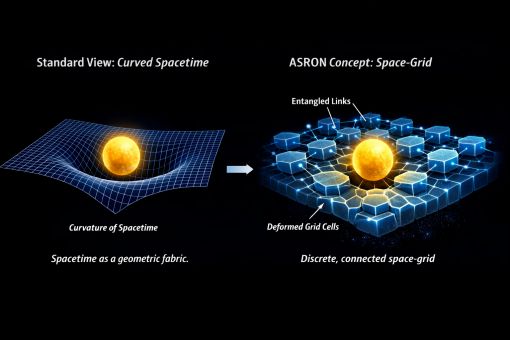
A Hidden Cosmic Ground Links Gravity, Entanglement, Dark Matter & Energy>  ASRON: A Foundations-First Model of Space-Grid Ontology A spaceoperational time-free reinterpretation consistent with General Relativity’s predictions
Graphical Abstract Caption Conceptual overview of the ASRON framework.
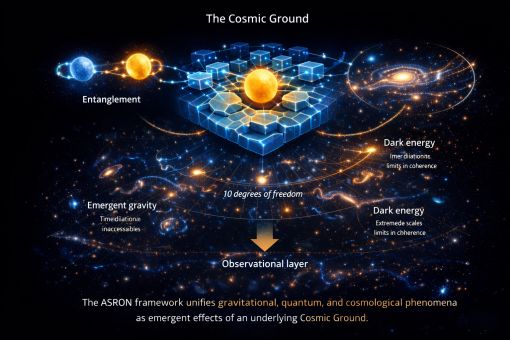
Graphical Abstract Caption (Popular-Science / Space Magazine Style) A new way to picture the universe beneath what we can observe.
Abstract Contemporary physics successfully predicts gravitational and quantum phenomena through General Relativity and quantum field theory, yet fundamental questions regarding the ontological nature of space, time, gravity, quantum entanglement, dark matter, and dark energy remain unresolved. While existing theories provide precise mathematical descriptions, they do not identify a common physical substrate underlying these effects. As a result, phenomena such as nonlocal quantum correlations, the absence of gravitons, the nature of spacetime singularities, and the origin of cosmic acceleration persist as open conceptual problems. This work introduces ASRON, a foundational framework in which space is composed of discrete, entangled units (“Asron blocks”) forming a coherent space-grid. The discrete space-grid formed by ASRON blocks is collectively referred to as the Cosmic Ground. The Cosmic Ground denotes the fundamental ontological substrate underlying all physical phenomena, prior to any effective description in terms of spacetime geometry. It is not itself spacetime, nor a force-carrying medium, but an information-supporting structure from which spatial extension, causal connectivity, and dynamical behavior emerge.
In this model, gravity, quantum entanglement, and cosmological phenomena arise as collective behaviors of the same underlying structure. Time is not treated as an intrinsic dimension but as an operational parameter derived from sequential transitions between adjacent Asron blocks (“universal ticks”), while spacetime curvature emerges as an effective descriptive construct rather than a physical substance. Within the ASRON framework, gravitational waves correspond to coherent oscillations of the space-grid, black holes represent coherence limits rather than physical singularities, and event horizons function as information boundaries. Quantum entanglement and apparent instantaneous information transfer arise naturally from nonlocal grid connectivity without violating relativistic causality. Dark matter effects are reinterpreted as gravitational participation of entangled but non-baryonic grid regions, while dark energy reflects large-scale grid relaxation dynamics rather than vacuum energy. ASRON reproduces all empirically verified predictions of General Relativity and relativistic kinematics, including equivalence principle outcomes, gravitational redshift, velocity-dependent time dilation, and gravitational wave propagation, while simultaneously providing a unified ontological explanation for phenomena traditionally treated as independent mysteries. By replacing spacetime with a discrete, entangled space-grid, ASRON offers a coherent physical foundation that integrates gravity, quantum nonlocality, and cosmology within a single explanatory framework and yields distinct, testable expectations for future observations.
Introduction The past century of physics has been dominated by two remarkably successful yet conceptually unresolved frameworks: General Relativity (GR) and quantum field theory. General Relativity accurately predicts gravitational phenomena across an extraordinary range of scales, from planetary motion to gravitational waves, while quantum theory governs the behavior of matter and energy at microscopic scales. Despite this success, their coexistence exposes deep conceptual tensions, particularly concerning the nature of spacetime, gravity, and the origin of cosmological phenomena such as dark matter and dark energy. General Relativity describes gravity as the curvature of spacetime, yet it does not specify what spacetime is physically. The mathematical formalism yields correct results, but its ontological interpretation remains ambiguous. This ambiguity becomes most apparent near black hole horizons, in attempts to quantize gravity, and in the persistent absence of experimental evidence for gravitons. Similarly, the standard cosmological model attributes approximately 95% of the universe’s gravitational behavior to dark matter and dark energy, neither of which has been directly observed as physical substances despite extensive experimental efforts. These unresolved issues suggest that the limitations may not lie in the equations themselves, but in the ontological assumptions underlying them. Much like perspective geometry accurately describes visual projections without implying that objects physically shrink with distance, spacetime curvature may be a powerful descriptive tool rather than a literal physical deformation of reality. In this work, we propose ASRON as an ontological replacement for spacetime-based interpretations, not as a modification of established equations. ASRON posits that space consists of discrete, quantized units—Asron blocks—entangled into a coherent space-grid. Motion corresponds to transitions between adjacent blocks, defining a universal operational unit (“tick”) from which time is derived as a convenient bookkeeping parameter rather than a fundamental dimension. In this work, the discrete space-grid formed by ASRON blocks is collectively referred to as the Cosmic Ground. The Cosmic Ground denotes the fundamental ontological substrate underlying all physical phenomena, prior to any effective description in terms of spacetime geometry. It is not itself spacetime, nor a force-carrying medium, but an information-supporting structure from which spatial extension, causal connectivity, and dynamical behavior emerge. Within the ASRON framework, “The Cosmic Ground includes ten effective degrees of freedom, which are modeled as an underlying ten-dimensional ground structure beneath the observable universe, of which only three spatial dimensions are directly accessible to macroscopic observation. The remaining dimensions remain compact, operational, or informational in nature, contributing to phenomena such as gravitational dynamics, entanglement correlations, and horizon-related effects without requiring their explicit geometric manifestation in observable space. This dimensional structure is not introduced ad hoc, but arises naturally from the consistency requirements of discrete space, invariant signal propagation, and operational limits at the Planck scale.
Within this framework, gravitational phenomena arise from grid deformation and coherence variations, while gravitational waves emerge as collective oscillatory modes of the grid. Black holes represent coherence limits where classical descriptions fail, and event horizons function as information boundaries rather than physical singularities. Dark matter effects emerge naturally from nonlocal grid participation, and cosmic acceleration is interpreted as large-scale grid relaxation rather than vacuum energy. ASRON preserves all verified predictions of General Relativity, including equivalence principle outcomes, gravitational redshift, velocity-dependent time dilation, and gravitational wave behavior, while offering a deeper explanatory layer that addresses longstanding conceptual gaps. By reframing gravity, time, and cosmology in terms of a discrete, entangled space-grid, ASRON provides a coherent foundation that aligns with existing observations and offers new, testable expectations for future experiments.
Note on Interpretation
Table 1. Previously Disconnected Physical Problems Reinterpreted Within a Single Ontological Framework
The table summarizes how ASRON provides a unified ontological reinterpretation of phenomena traditionally treated as separate theoretical problems, while preserving all empirically verified predictions.
Before introducing the technical formulation of ASRON, it is useful to summarize how a single ontological assumption leads to consistent reinterpretations of several long-standing and seemingly unrelated physical problems. Table 1 provides an overview of these correspondences and serves as a conceptual guide for the sections that follow. What ASRON Explains Within a Single Ontological Framework
Unifying Previously Disconnected Problems Under a Single Ontology One of the central motivations behind ASRON is the observation that many of the most persistent problems in modern physics arise not from failed predictions, but from fragmented ontological assumptions. Gravity, quantum nonlocality, dark matter, dark energy, and horizon-related paradoxes are traditionally treated as independent phenomena requiring separate theoretical constructs. ASRON proposes that these issues are not fundamentally distinct, but rather different manifestations of the same underlying space-grid dynamics. In standard physics, gravity is geometrized as spacetime curvature, while quantum entanglement is treated as an irreducible nonlocal feature with no spacetime-based explanation. Dark matter and dark energy are introduced as additional components to reconcile theory with observation, yet remain experimentally elusive. Event horizons and singularities generate paradoxes precisely because classical spacetime concepts are pushed beyond their domain of applicability. ASRON removes these tensions by replacing spacetime with a discrete, entangled space-grid composed of Asron blocks. Within this framework, gravity, quantum entanglement, and cosmological effects emerge as collective behaviors of the same structure, rather than requiring distinct ontological entities. Nonlocal correlations arise naturally from grid connectivity, gravitational phenomena from grid deformation and coherence limits, and cosmological anomalies from large-scale grid dynamics. This unified approach explains why phenomena traditionally labeled as “mysteries” appear precisely at the boundaries of spacetime-based descriptions. In ASRON, such boundaries correspond to operational limits of grid coherence, information accessibility, or observational perspective, not to physical breakdowns of reality itself. As a result, ASRON reframes long-standing problems as consequences of descriptive overreach rather than fundamental inconsistencies in nature.
From Einstein Field Equations to ASRON
Gravitational Waves as Space-Grid Oscillations
Time Dilation as Grid Operational Slowdown
Black Holes: Coherence Limits and Event Horizon
Singularity, Information, and the Limits of Classical Description
In this interpretation, the singularity is not a place where “physics becomes infinite,” but a boundary beyond which classical concepts—such as continuous spaceoperational time, localized trajectories, and well-defined temporal ordering—lose their applicability. The physical substrate, namely the discrete space-grid composed of Asron blocks, does not require infinite quantities; rather, it reaches a coherence limit beyond which conventional measurement and description fail. Inside-Horizon Physics Physics inside the event horizon must therefore be treated with particular care. ASRON does not claim to provide a classical description of interior black hole dynamics. Instead, it asserts that inside-horizon physics loses its classical meaning, not because physical reality ceases to exist, but because the grid coherence necessary for classical information transfer and observation is no longer available. Within this regime, familiar notions such as spatial separation, temporal sequence, and causal signaling cannot be operationally defined in the usual way. The loss is not of physical existence, but of classical accessibility. As a result, attempting to extrapolate standard spaceoperational time-based intuition beyond the horizon inevitably leads to apparent paradoxes, including infinite curvature and singular behavior. Event Horizon as an Information Boundary In ASRON, the event horizon is interpreted as an information boundary, not a material surface. While energy transfer across the horizon remains possible, the detailed microstate information required to reconstruct internal configurations becomes inaccessible to external observers. This distinction is crucial: information is not destroyed, but rendered unreachable within the operational limits of the external space-grid domain. This view aligns naturally with black hole thermodynamics. The entropy associated with a black hole is interpreted not as a measure of internal disorder, but as a quantitative expression of lost informational accessibility. Entropy, in this sense, reflects the number of internal configurations that can no longer be distinguished or retrieved by observers outside the horizon. Entropy and Information Preservation ASRON therefore maintains full information preservation at the fundamental level of the space-grid. No information is annihilated at the event horizon; instead, the grid transitions into a regime where information exchange across domains is no longer operationally supported. The increase in entropy corresponds to this growing gap between total information content and accessible information. Hawking radiation can be consistently understood within this framework as a boundary phenomenon. Near-horizon grid oscillations allow limited energy and statistical information to emerge in thermal form, while the detailed internal state remains inaccessible. This preserves the thermodynamic description of black holes without requiring spaceoperational time itself to be treated as a physical substance.
The Two-Tick Inequality as an Operational Limit
The Two-Tick Inequality and the Operational Limit of the Space-Grid Within the ASRON framework, fundamental physical limits are not interpreted as constraints imposed by an abstract operational time dimension, but as operational bounds inherent to the discrete structure of the space-grid itself. The Planck scale is therefore reinterpreted as an operational threshold rather than a minimum unit of operational time or length in a literal sense. The Two-Tick Inequality ASRON introduces an operational inequality expressed as:
This expression does not represent a physical law in the form of a dynamical equation, nor does it replace or reproduce Einstein’s Field Equations. Instead, it defines an operational limit: the minimum number of discrete grid transitions—Universal Ticks—required to traverse a single Asron block under any physical circumstance. A single Universal Tick corresponds to the most elementary unit of physical change: a transition from one Asron block to an adjacent one. To operationally cross a block—to move matter, energy, or information beyond it—requires at least two such ticks. Attempting to compress this process below the two-tick threshold exceeds the grid’s coherence capacity. Planck Scale as a Coherence Boundary From this perspective, the Planck operational time does not signify a smallest “operational time interval” in a fundamental temporal dimension. Rather, it marks the point at which the operational integrity of the grid can no longer support classical propagation. When mass–energy density forces the grid toward a regime where fewer than two operational ticks would be required, grid coherence fails. This failure does not imply the breaking or annihilation of Asron blocks. Instead, the grid loses its normal operational functionality: it can no longer transmit classical information or support continuous causal descriptions. This regime corresponds physically to the formation of a black hole.
Why Two Ticks? — The Minimum Operational Requirement In the ASRON framework, an Asron block represents the smallest operationally complete unit of space. A Universal Tick corresponds to a single admissible transition between two adjacent Asron blocks. This transition is indivisible: it is the minimal unit of physical change. However, crossing an Asron block—meaning transferring matter, energy, or information from one side of a block to the other—cannot be achieved with a single tick. One tick only moves a system to the next block. To move beyond that block, a second transition is required. Hence, two Universal Ticks constitute the minimum operational cycle necessary to traverse a single Asron block. This is why the fundamental operational inequality is not expressed as a single-tick limit, but as a two-tick threshold. Planck Scale as a Compression Boundary Asron blocks are quantized at the Planck volume. They cannot be compressed beyond this scale. Importantly, this does not imply that the blocks themselves are damaged, fractured, or destroyed. The blocks remain intact. What changes under extreme mass–energy density is the bonding and operational coupling between adjacent blocks. As compression increases toward the Planck limit, the bonding between two neighboring Asron blocks becomes progressively strained. When physical conditions would require the system to operate with fewer than two ticks per block traversal, the bonding can no longer sustain its normal function. At this point, the coupling between blocks ceases to operate in a classical, information-transmitting manner. Crucially:
This distinction is essential. Black hole formation, in ASRON, is therefore not a collapse of space into a point, but a transition into a regime where inter-block bonding loses operational coherence. Black Holes as Bonding Failure, Not Structural Destruction When the two-tick requirement cannot be satisfied, the grid enters a non-operational regime. Classical causality, signal propagation, and operational time-ordering cease to be definable—not because operational time has ended, but because the grid can no longer support the operational cycles required for classical description. This explains why:
All of these are manifestations of bonding failure, not infinite density or physical destruction.
Relation to Hawking Radiation
Equivalence Principle, Velocity-Dependent Time Dilation, and Operational Consistency in ASRON
In each case, the mathematical formalism of relativity remains fully valid. ASRON does not modify the equations that yield correct predictions; instead, it provides an alternative physical substrate that explains why these equations work. Time Dilation Near Black Holes: Operational Slowdown at the Coherence Limit Near the event horizon of a black hole, the grid approaches its coherence limit. The operational cost required to maintain grid integrity under extreme mass–energy density increases sharply, leaving progressively fewer operational cycles available for internal processes. To an external observer, this appears as extreme operational time dilation, culminating in the apparent “freezing” of infalling matter at the horizon. Within ASRON, this effect is not attributed to operational time itself becoming infinite or halting. Rather, it reflects the grid reaching a regime where classical operational descriptions lose applicability. The predictions of General Relativity remain intact, but their interpretation shifts from geometric inevitability to operational limitation. Conceptual Summary ASRON therefore achieves a critical balance:
Spin-2, the Graviton Problem, and Collective Grid Modes in ASRON In conventional quantum gravity approaches, gravity is expected to be mediated by a fundamental particle: the graviton, typically defined as a massless spin-2 boson propagating on a spaceoperational time background. Despite decades of theoretical development, no experimental evidence for such a particle has been found. Within the ASRON framework, this absence is not a problem to be solved—it is an expected outcome. Why a Fundamental Graviton Is Not Required ASRON does not treat gravity as a force transmitted by particle exchange. Instead, gravity arises from collective, coherent deformations of the space-grid itself. Asron blocks form a discrete, quantized grid, and what General Relativity describes as “curvature of spaceoperational time” is reinterpreted as variations in bonding strength, orientation, and coherence across the grid. In this picture:
Thus, searching for a graviton as an isolated particle is analogous to searching for a “phonon atom” instead of recognizing sound as a collective excitation of a medium. Spin-2 as an Effective Description The spin-2 mathematical structure that appears in Einstein’s Field Equations is not discarded in ASRON. Instead, it is reinterpreted. Spin-2 is the effective mathematical description of a collective grid mode, not evidence of a fundamental particle. The symmetry properties of spin-2 fields arise naturally when:
All of these conditions emerge from coherent oscillations of the Asron grid, exactly as required to reproduce General Relativity’s successful predictions. Thus:
It describes how the grid responds, not what the grid is made of. Gravitational Waves as Space-Grid Oscillations In ASRON, gravitational waves are interpreted as propagating oscillatory modes of grid coherence. These oscillations do not carry spaceoperational time itself; rather, they modulate the operational relationships between Asron blocks. This interpretation is fully compatible with EFE predictions:
No contradiction arises with LIGO/Virgo observations; instead, the observations confirm the collective-mode nature of gravity. Why the Graviton Has Not Been Detected ASRON provides a direct explanation for the graviton’s absence:
In this sense, ASRON does not fail to predict the graviton—it predicts its non-existence as a fundamental particle.
Equivalence Principle, Velocity-Dependent Time Dilation, and Operational Consistency in ASRON One of the strongest empirical pillars of General Relativity is the Equivalence Principle: locally, gravitational effects are indistinguishable from inertial acceleration. Any viable foundational replacement must reproduce this principle without exception. ASRON does so naturally—without invoking spaceoperational time as a physical entity. Equivalence Principle as Local Grid Uniformity In ASRON, all physical processes occur through transitions between Asron blocks via Universal Ticks. A local observer measures physics by counting operational transitions, not by referencing an external operational time coordinate. The Equivalence Principle emerges because:
Thus, locally:
There is no need for spaceoperational time curvature; local grid symmetry alone suffices. Velocity-Dependent Time Dilation as Grid Operational Load In Special Relativity, operational time dilation arises from relative velocity. In ASRON, this effect is reinterpreted as an increase in grid operational demand. As velocity increases:
Importantly:
This manifests observationally as operational time dilation. Time does not slow; operational capacity is redistributed. Gravitational Time Dilation as Bond Functional Degradation Near massive objects, gravitational operational time dilation appears. In ASRON, this is not due to “slower operational time,” but to reduced grid coherence efficiency. As mass-energy increases:
This degradation is continuous and smooth—until a critical threshold is reached. The Two-Tick Operational Limit A fundamental constraint arises from grid discreteness: An Asron block cannot be operationally traversed in fewer than two Universal Ticks. This yields the inequality:
This is not a statement about operational time, but about grid integrity.
This marks the onset of grid coherence failure. Black Hole Vicinity: Grid Coherence Limit At extreme mass-energy densities:
This is what classical theory calls the event horizon. Crucially:
There is only a loss of operational connectivity. Operational Consistency with General Relativity Despite its radically different ontology, ASRON preserves all tested predictions of General Relativity:
Einstein’s equations work because they accurately describe outcomes, not because spaceoperational time is ontologically real. Just as perspective geometry predicts correct visual relations without altering the rails themselves, EFE predicts correct physics without revealing the true substrate. With operational time dilation and equivalence understood as grid-operational effects, we can now address the deep questions that arise near horizons:
Singularity, Information Horizon, and Entropy in ASRON In the ASRON framework, the concepts of singularity, event horizon, and entropy are reinterpreted not as physical infinities or breakdown points of nature, but as operational and informational limits of the space-grid. Singularity Is Not a Physical Object In classical General Relativity, singularities emerge as mathematical divergences where curvature, density, or tidal forces formally approach infinity. ASRON interprets these infinities as signals of model breakdown, not as physical entities. Within ASRON, space is composed of discrete Asron blocks quantized at the Planck volume. These blocks themselves cannot be compressed beyond the Planck scale and are not destroyed. Instead, what fails near the classical singularity is the functional coherence of inter-block bonding. Thus, a “singularity” corresponds to:
There is no point of infinite density; rather, there is a boundary beyond which physical description loses operational meaning. Event Horizon as an Information Boundary The event horizon is redefined in ASRON not as a physical surface, but as an information horizon. As mass-energy approaches the grid coherence limit:
This results in:
Importantly, nothing “stops” locally. The apparent operational time dilation is an observer-dependent manifestation of grid operational slowdown, consistent with General Relativity but ontologically distinct. Inside-Horizon Physics Loses Classical Meaning Beyond the information horizon, classical spaceoperational time concepts such as:
cease to be valid descriptions. ASRON does not claim to describe “what happens inside” in classical terms. Instead, it asserts that inside-horizon physics is non-operational for external reference frames, not because laws fail, but because information exchange is no longer defined. This aligns naturally with the absence of observational access and removes the need for speculative internal geometries. Entropy as Lost Accessibility, Not Disorder Entropy in ASRON is not fundamentally about microscopic disorder, but about loss of accessible information across the space-grid. As grid coherence degrades:
This interpretation:
Information Preservation Without Spaceoperational time Substance Because ASRON does not treat spaceoperational time as a physical substance, information is not destroyed at singularities. Instead:
This allows compatibility with:
Relation to Hawking Radiation Hawking radiation is interpreted as a near-horizon boundary effect arising from fluctuations at the grid coherence limit:
This preserves the thermodynamic description of black holes without requiring spaceoperational time itself to be treated as a physical medium. Relation to Einstein’s Tensor The two-tick inequality bears a heuristic parallel to the role played by Einstein’s tensor in General Relativity. Both identify limits beyond which classical descriptions cease to apply. However, ASRON makes no claim of mathematical equivalence. The inequality does not encode curvature, stress–energy relations, or spaceoperational time geometry. Rather, it offers a physical interpretation of why Einstein’s equations signal divergence near singular regimes: the equations are correctly identifying an operational boundary, not a physical infinity. In this sense, the two-tick inequality provides an ontological explanation for the breakdown indicated by classical tensors, without replacing their descriptive role. Light Speed and Universal Tick Invariance The constancy of the speed of light follows naturally from this framework. Regardless of how distorted, stretched, or operationally slowed an Asron block becomes, transitioning from one block to the next always requires exactly one Universal Tick. No physical process can reduce this requirement. Thus, the speed of light is not enforced by spaceoperational time geometry, but by the invariance of the grid’s minimal operational transition. This invariance remains valid even in extreme gravitational environments, including near event horizons. Operational Interpretation Summary
Why the Graviton Has Not Been Observed: The ASRON Interpretation In conventional quantum gravity approaches, gravity is assumed to be mediated by a fundamental spin-2 particle—the graviton. Despite decades of theoretical development and experimental effort, no direct or indirect evidence of such a particle has been found. Within the ASRON framework, this absence is not accidental but expected. ASRON proposes that gravity is not a force transmitted by particle exchange, but an emergent, collective mechanical effect of the underlying space-grid composed of discrete ASRON blocks. In this picture, what is mathematically described as a “spin-2 graviton” in perturbative quantum gravity corresponds not to a fundamental particle, but to an effective collective excitation mode of the grid. Graviton as an Effective Description, Not an Ontological Entity The spin-2 character attributed to gravitons arises naturally from the tensorial structure of Einstein’s Field Equations. However, within ASRON, this mathematical structure is interpreted as a macroscopic descriptor of collective grid behavior, rather than evidence for a microscopic particle degree of freedom. In other words: The spin-2 graviton is a mathematical encoding of grid-level coherence and response, not a fundamental quantum object. This explains why:
Why Gravitons Are Not Localizable in ASRON ASRON blocks are defined at Planck-scale volume, forming a continuous operational grid. Gravity emerges from:
There is therefore no physical mechanism for isolating a single “gravity quantum” analogous to photons or gluons. Any attempt to localize gravity beyond the coherence length of the grid destroys the conditions under which gravity is defined. This naturally explains:
Relation to Gravitational Waves Within ASRON, gravitational waves are interpreted as propagating oscillatory modes of the space-grid, fully consistent with Einstein’s predictions for wave speed, polarization, and energy transport. However, these waves do not decompose into particle quanta at the microscopic level. This parallels condensed-matter systems, where:
Similarly, the graviton emerges as a useful descriptive construct, not as an ontologically required particle. Summary (Key Claim) ASRON replaces the graviton hypothesis with a deeper structural explanation:
Quantum Entanglement and Instant Information Transfer in the ASRON Framework. Entanglement as a Grid-Level Phenomenon Entanglement and nonlocal correlations are interpreted in ASRON as operational features of the Cosmic Ground. Within this framework, entangled systems do not exchange signals across spacetime. Instead, they remain jointly defined through shared configurations of the Cosmic Ground. What appears as instantaneous information transfer is, therefore, not transmission through space, but the manifestation of a single underlying ground-state constraint acting across multiple localized projections. This interpretation preserves all experimentally verified predictions of quantum mechanics while removing the need for superluminal signaling or causal violations within spacetime. In the ASRON framework, quantum entanglement is not interpreted as a mysterious nonlocal connection between spatially separated particles. Instead, entanglement reflects a shared configuration of the underlying space-grid. Two entangled systems may occupy distant spatial locations, yet they remain embedded within the same coherent grid state. The correlation observed during measurement does not arise from any signal exchanged between particles, but from the fact that both measurements probe a single global constraint of the space-grid. Thus, entanglement in ASRON is nonlocal only in appearance, while remaining fully consistent with locality at the level of the grid. Instant Correlation Without Signal Propagation The apparent instantaneous nature of entanglement correlations does not imply superluminal information transfer. In ASRON:
Measurement does not transmit information across space. Instead, it reveals a pre-existing correlation encoded in the shared grid state. The update is not temporal in nature but logical and global, governed by grid-level consistency. This distinction preserves causality and aligns fully with relativistic constraints. Operational Time and the Absence of Temporal Ordering Since time in ASRON is defined operationally—as the counting of motion via Universal Ticks—entanglement does not occur in time. There is no meaningful sense in which one measurement “happens before” the other at the grid level. Temporal ordering emerges only locally, at the observer’s operational scale. Consequently:
This resolves long-standing conceptual tensions between quantum nonlocality and relativistic simultaneity. Relation to Bell Inequalities Violations of Bell inequalities are naturally accommodated in ASRON. The hidden variables excluded by Bell’s theorem are assumed to be particle-local. ASRON introduces no such variables at the particle level. Instead, correlations are determined by global grid topology, which lies outside the assumptions of local realism tested by Bell-type experiments. Thus, Bell violations indicate not nonlocal signaling, but the inadequacy of particle-centric ontologies. Why Entanglement Cannot Be Used for Faster-Than-Light Communication Despite instantaneous correlations, entanglement cannot transmit controllable information faster than light because:
ASRON fully preserves this no-signaling constraint while providing an ontological explanation for why entanglement appears instantaneous. “Once the space-grid is understood as a globally coherent structure—capable of enforcing instantaneous correlations without signal transfer—it becomes natural to consider that different observational domains may emerge within the same grid. This perspective directly informs the interpretation of dark matter as a grid-domain phenomenon rather than unseen particulate mass.” Summary Within ASRON, entanglement is reinterpreted as a manifestation of grid-level coherence rather than particle-level interaction. Instant correlations arise from shared structural constraints of space itself, not from violations of causality or relativity. This view removes the need for mysterious nonlocal forces, while maintaining complete agreement with experimental quantum mechanics.
Dark Matter as a Grid-Domain Phenomenon in the ASRON Framework (Revised) Dark Matter as a Manifestation of the Cosmic Ground Entanglement → Dark Matter In standard cosmology, dark matter is introduced as an unseen particulate component required to account for gravitational effects that cannot be explained by luminous matter alone. These effects include anomalous galactic rotation curves, gravitational lensing discrepancies, and large-scale structure formation. Despite decades of experimental effort, no dark matter particle has been directly detected, and its physical nature remains unknown. Within the ASRON framework, these phenomena are reinterpreted without introducing additional particle species. Instead, dark matter effects arise as gravitational participation of the Cosmic Ground beyond directly observable degrees of freedom. The Cosmic Ground includes ten effective degrees of freedom, of which only a subset project into observable three-dimensional space. Mass–energy configurations embedded within other operational regimes of the Cosmic Ground may remain electromagnetically inaccessible while still contributing to gravitational dynamics. This interpretation naturally follows from the same ground-level structure responsible for quantum entanglement. Just as entangled systems remain correlated without exchanging signals across spacetime, gravitational influence can arise from nonlocal or partially decoupled ground configurations. In this sense, dark matter does not correspond to “missing matter” located somewhere else in space, but to inaccessible or non-projecting components of the same underlying Cosmic Ground. From this perspective, the gravitational effects attributed to dark matter reflect the collective response of the space-grid to mass–energy distributions that are not confined to observable baryonic matter. These contributions manifest through the grid’s coherence and deformation properties rather than through localized particle interactions. As a result, dark matter effects are inherently nonlocal and need not follow the clustering behavior expected from particulate matter alone. Importantly, this reinterpretation preserves all successful phenomenology of dark matter within General Relativity. Rotation curves, lensing effects, and large-scale structure formation remain consistent with observation, while the absence of direct particle detection is no longer paradoxical. The Cosmic Ground framework thus explains why dark matter behaves gravitationally yet evades electromagnetic detection, without requiring additional assumptions beyond the structure already introduced to account for entanglement and horizon phenomena. In ASRON, dark matter is therefore not a separate substance but an emergent gravitational signature of the Cosmic Ground’s extended degrees of freedom. This unifies quantum nonlocality and cosmological mass discrepancies within a single ontological framework, suggesting that both arise from the same underlying structure rather than from distinct physical entities.
Shared Grid, Distinct Domains Entanglement demonstrates that spatial separation does not preclude instantaneous correlation when systems share a common grid configuration. By analogy, dark matter may occupy regions of the same space-grid that do not participate in electromagnetic interactions within our domain, while still contributing to the overall grid stress and curvature experienced locally. Thus:
This interpretation preserves all observational evidence attributed to dark matter while removing the necessity for ad hoc particle hypotheses. Why Dark Matter Is Invisible Visibility in ASRON is not determined by spatial proximity, but by operational coupling to the grid. Electromagnetic interactions require specific grid modes that are active within our observational domain. Dark matter configurations lack access to these modes, rendering them invisible while remaining gravitationally effective. This domain separation is conceptually aligned with the entanglement framework:
Consistency with Relativity and Causality Because dark matter effects arise from shared grid structure rather than signal transfer, this interpretation does not violate relativistic causality. No information flows from dark matter domains into ours; only the static or slowly evolving grid configuration is jointly experienced. This aligns naturally with:
Implications Reframing dark matter as a grid-domain phenomenon resolves several longstanding issues:
Moreover, it situates dark matter within the same conceptual framework that explains entanglement, gravitational waves, and time dilation—namely, the global behavior of the space-grid. If distinct grid domains can coexist within a shared space-grid, it becomes natural to ask whether large-scale grid dynamics—rather than unseen energy components—may underlie cosmic acceleration.
Falsifiability and Observational Constraints The Cosmic Ground interpretation of dark matter is falsifiable in several ways. If future experiments conclusively identify dark matter as a localized, weakly interacting particle species with independently conserved degrees of freedom, this would directly challenge the ASRON framework. Likewise, precise observations demonstrating strictly local gravitational behavior incompatible with nonlocal ground-level participation would disfavor this interpretation. Conversely, continued non-detection of dark matter particles, combined with gravitational phenomena exhibiting nonlocal or coherence-based signatures inconsistent with particulate clustering alone, would strengthen the Cosmic Ground hypothesis. ASRON therefore makes clear empirical commitments while reframing the conceptual origin of dark matter effects.
Dark Energy as a Large-Scale Response of the Cosmic Ground In contemporary cosmology, dark energy is introduced to explain the observed accelerated expansion of the universe. It is typically modeled as a cosmological constant or as a dynamically evolving field with negative pressure. Despite its central role in the standard cosmological model, the physical nature of dark energy remains deeply unclear, with no direct experimental access to its microscopic origin. Within the ASRON framework, dark energy is not treated as an independent substance or field permeating spacetime. Instead, it emerges as a global, large-scale response of the Cosmic Ground to cumulative mass–energy distribution and coherence constraints. While dark matter effects arise from inaccessible or non-projecting degrees of freedom contributing gravitationally, dark energy reflects how the Cosmic Ground accommodates and relaxes under long-term, large-scale deformation. The Cosmic Ground possesses ten effective degrees of freedom, only a subset of which project into observable spatial dimensions. As matter aggregates and structure forms, these degrees of freedom redistribute operational capacity across the grid. At cosmological scales, this redistribution manifests not as additional attractive force, but as a progressive reduction in effective gravitational coherence between distant regions, producing the appearance of accelerated expansion. In this view, cosmic acceleration does not require a repulsive energy component. Rather, it reflects the operational limits of grid coherence over extreme distances, where correlations within the Cosmic Ground weaken in a scale-dependent manner. The expansion rate thus encodes information about the global state of the grid, not about vacuum energy density or exotic fields. This interpretation naturally complements the ASRON account of entanglement and dark matter. Quantum nonlocality, dark matter effects, and cosmic acceleration are not separate anomalies requiring distinct explanations, but different scale-dependent expressions of the same underlying Cosmic Ground structure. Entanglement reflects coherence at the smallest scales, dark matter reflects hidden gravitational participation at intermediate scales, and dark energy reflects coherence limits at the largest cosmological scales. Importantly, this reinterpretation preserves all observational successes of dark energy models, including supernova luminosity-distance relations, cosmic microwave background constraints, and large-scale structure evolution. The ASRON framework reproduces these effects without introducing an explicit cosmological constant, instead attributing accelerated expansion to emergent properties of the ground-level structure. Unified Figure Caption: Dark Matter & Dark Energy This caption is meant for one conceptual schematic that visually unifies entanglement, dark matter, and dark energy as scale-dependent manifestations of the Cosmic Ground. Figure Y. The Cosmic Ground as a Unified Origin of Dark Matter and Dark Energy Conceptual schematic illustrating how different scale-dependent manifestations of the Cosmic Ground give rise to dark matter and dark energy phenomena.
Falsifiability and Observational Constraints The Cosmic Ground interpretation of dark energy is falsifiable through several observational avenues. If future measurements demonstrate that cosmic acceleration arises from a strictly local vacuum energy density with fixed equation-of-state parameters independent of large-scale structure, this would challenge the ASRON framework. Similarly, evidence for a fundamental repulsive field acting uniformly across spacetime would disfavor a coherence-based explanation. Conversely, scale-dependent deviations from constant dark energy behavior, correlations between large-scale structure formation and acceleration rates, or signatures of evolving coherence limits would support the Cosmic Ground interpretation. ASRON therefore remains empirically constrained while offering a unified, non-substantive explanation of cosmic acceleration. Testable Predictions and Observational Signatures The ASRON interpretation of dark energy leads to several testable predictions that distinguish it from models based on a fundamental cosmological constant or scalar field:
These predictions provide clear observational avenues through which the Cosmic Ground framework can be tested and constrained, while remaining fully compatible with existing cosmological data.
Global Grid Expansion vs Local Observables ASRON treats space as a grid composed of discrete blocks operating under global coherence constraints. While local mass–energy configurations deform the grid and produce gravitational attraction, the grid itself may undergo collective large-scale operational adjustments. At cosmological scales, these adjustments can appear as an effective repulsive behavior when interpreted through local operational metrics. In other words, what is observed as accelerated expansion may reflect a global grid relaxation or redistribution process, rather than the presence of an exotic energy component. This interpretation preserves all empirical observations associated with dark energy while reframing their underlying cause. Relation to Grid Domains and Entanglement As established in the discussion of entanglement and dark matter, the space-grid can support distinct observational domains that share a common global structure. The cumulative influence of these domains may contribute to large-scale grid behavior without direct local interaction. Dark energy effects, in this view, may arise from:
Importantly, this does not imply information or energy transfer between domains, but rather a shared global constraint. Why Dark Energy Appears Uniform Observations indicate that dark energy is spatially uniform and dominant at large scales. This is naturally explained in ASRON, where grid-level dynamics operate independently of local matter clustering. Local gravitational effects dominate small scales, while global grid behavior becomes significant only when averaged over cosmological distances. This scale separation explains why dark energy does not interfere with local dynamics yet governs cosmic expansion. Status of the Hypothesis It is important to emphasize that, within ASRON, the interpretation of dark energy as a grid-dynamic phenomenon remains hypothetical. Unlike dark matter, which directly maps to observable gravitational effects at galactic scales, dark energy concerns the behavior of the grid as a whole. ASRON does not claim a definitive mechanism at this stage but provides a coherent conceptual framework in which cosmic acceleration does not require the introduction of unexplained energy components. Conceptual Advantages Reframing dark energy in terms of space-grid dynamics offers several advantages:
In this sense, dark energy becomes not a separate mystery, but a large-scale expression of the same underlying structure that governs all physical phenomena in the ASRON framework.
Unified Interpretation of Dark Matter and Dark Energy in the ASRON Framework Within the ASRON framework, both dark matter and dark energy are not treated as independent physical substances or exotic additions to known physics. Instead, they emerge as distinct large-scale manifestations of a single underlying space-grid structure, governed by different operational regimes of the same ontology. This unification resolves the conceptual fragmentation present in standard cosmology. Dark Matter as Nonlocal Grid Participation Dark matter is interpreted as mass–energy that participates in the same space-grid but remains operationally decoupled from baryonic interaction channels. Key characteristics:
In ASRON, this implies that dark matter occupies regions or modes of the grid that are adjacent, overlapping, or entangled with observable space, yet remain inaccessible to direct detection. This explains why dark matter:
without invoking undiscovered particles. Entanglement as the Common Mechanism A central insight of ASRON is that entanglement is not a secondary quantum feature, but an intrinsic property of the space-grid itself.
all arise from persistent grid entanglement across spatial domains. Thus, dark matter effects emerge where entanglement bridges grid regions with different interaction accessibility, while preserving gravitational coupling. Dark Energy as Global Grid Relaxation Dark energy represents a distinct operational regime of the same grid, manifesting not locally but globally. In ASRON:
It reflects a global relaxation or redistribution of grid tension as mass density decreases at cosmological scales. As local mass-induced grid strain diminishes, the grid enters a regime where:
This naturally produces the observed accelerated expansion without requiring a cosmological constant. Why Dark Matter and Dark Energy Are Linked In ΛCDM, dark matter and dark energy are unrelated entities introduced independently to fit observations. In ASRON, they are two faces of the same structure:
This removes:
Predictive Consequences of the Unified View This unified interpretation leads to concrete expectations:
Conceptual Advantage ASRON replaces a patchwork cosmology with a single ontological foundation, where:
Discussion and Conclusion The ASRON framework proposes a structural reinterpretation of fundamental physics in which spacetime is not treated as a physical entity, but rather as a derived descriptive construct arising from the operational behavior of a deeper, discrete substrate—the Cosmic Ground. This ground, characterized by ten degrees of freedom, provides a unified basis for gravitational phenomena, nonlocal correlations, horizon physics, and the apparent dark components of the universe. A central result of this work is the demonstration that all empirically validated predictions of General Relativity—including gravitational redshift, velocity-dependent time dilation, equivalence principle outcomes, and gravitational wave propagation—remain intact when reinterpreted as emergent effects of Cosmic Ground dynamics. Einstein’s field equations continue to function as accurate descriptive tools, not because spacetime is ontologically fundamental, but because the equations correctly encode how matter–energy distributions constrain the operational behavior of the underlying ground. Within this framework, gravitational waves are interpreted as coherent oscillatory modes of the space-grid rather than ripples in a physical spacetime fabric. Their observed spin-2 character and propagation properties emerge as effective collective behaviors of the grid, explaining both their compatibility with General Relativity and the persistent absence of a fundamental graviton particle. The graviton, in this view, is not missing but unnecessary: gravitational interaction is carried by the structure itself, not by an exchange particle. The treatment of time represents another key conceptual shift. Time is not assumed to be intrinsic, flowing, or fundamental. Instead, it is understood as a bookkeeping device—an invented metric that counts discrete operational transitions (“Universal Ticks”) between adjacent Asron blocks. Time dilation effects, including those near relativistic velocities and strong gravitational fields, correspond to slowdowns in grid-level operational capacity rather than to deformation of a time dimension. Near black hole horizons, this operational slowdown approaches a coherence limit, explaining the observational freezing of clocks without invoking physical singularities. This reinterpretation naturally resolves long-standing conceptual issues associated with singularities. In ASRON, singularities are not physical objects but indicators of breakdown in classical descriptive language. When grid coherence fails beyond operational limits, classical quantities such as time, distance, and curvature lose applicability. The event horizon thus becomes an information boundary rather than a material surface, and entropy is reinterpreted as a measure of lost accessibility rather than destroyed information. Dark matter and dark energy, often treated as independent mysteries requiring new substances or fields, emerge here as scale-dependent manifestations of the same Cosmic Ground. At galactic and cluster scales, non-projecting or inaccessible degrees of freedom contribute gravitationally, producing effects attributed to dark matter. At cosmological scales, redistribution limits of the ground’s operational capacity manifest as accelerated expansion. Both phenomena arise from structural constraints rather than exotic components, offering a unified explanation that preserves all observed behaviors while reducing ontological complexity. Quantum entanglement and apparent instantaneous correlations find a natural place in this picture. Because entangled systems remain linked through the same Cosmic Ground structure, correlations need not propagate through spacetime at all. No superluminal signaling occurs; rather, correlations reflect shared ground-level states. This resolves long-standing tensions between quantum nonlocality and relativistic causality without invoking hidden variables or retrocausal mechanisms. Importantly, ASRON does not reject existing theories; it reframes them. General Relativity, Quantum Field Theory, and Standard Model successes are preserved as effective, domain-limited descriptions, much like thermodynamics remains valid despite the existence of molecular theory. The contribution of ASRON lies not in replacing predictive machinery, but in offering an ontologically economical foundation beneath it. The framework also makes clear, falsifiable predictions. It anticipates scale-dependent deviations in cosmic acceleration, evolving dark-energy-like behavior with redshift, correlations between structure formation and expansion dynamics, and the continued absence of detectable gravitons. These predictions distinguish ASRON from both ΛCDM and emergent-gravity approaches, while remaining testable with current and forthcoming observational programs. In conclusion, ASRON proposes that the universe is governed not by spacetime as a physical substance, but by a deeper, structured Cosmic Ground whose operational constraints give rise to gravity, time, nonlocality, and cosmic evolution. By unifying gravitational phenomena, quantum correlations, horizon physics, and dark components under a single ontological framework, ASRON offers a coherent and parsimonious alternative to prevailing paradigms—one that preserves empirical success while resolving conceptual fragmentation at the foundations of modern physics.
Testable and Falsifiable Predictions of the ASRON Framework – old version Although ASRON is proposed as a foundational reinterpretation rather than a phenomenological fitting model, it nevertheless leads to distinct observational and experimental expectations that differentiate it from ΛCDM and particle-based extensions of General Relativity. These predictions arise directly from the ontology of a discrete, entangled space-grid composed of Asron blocks.
Prediction: Rationale: Implication:
Prediction: Possible Observables:
This differs from ΛCDM, where dark matter halos are treated as locally defined particle distributions.
Prediction:
Rationale: Observable Consequence:
Prediction: Potential signatures:
These effects should not appear at:
Prediction: While direct measurement is currently infeasible, indirect consequences include:
This reframes entanglement as a structural property of space, not merely a quantum curiosity.
Prediction: ASRON Interpretation: Gravitational waves remain fully consistent with GR predictions but are reinterpreted as: coherent oscillatory modes of the space-grid.
Prediction:
This aligns naturally with:
Falsifiability Summary ASRON would be strongly challenged if any of the following were confirmed:
Positioning Statement ASRON does not replace General Relativity’s predictions; it replaces the ontological interpretation underlying those predictions. General Relativity remains descriptively correct,
Potentially Testable Predictions of the ASRON Framework The ASRON framework does not introduce new free parameters or exotic particles. Consequently, its predictive power lies not in altering existing numerical results, but in distinct structural and phenomenological expectations that differ from particle-based or spacetime-centric interpretations.
Prediction: Rationale: Testability:
Discriminates against:
Prediction: Rationale: Testability:
Prediction: Rationale: Testability:
Discriminates against:
Prediction: Rationale: Testability:
Prediction: Rationale: Testability:
Prediction: Rationale: Testability:
Dark Energy: Testable Expectations in the ASRON Framework In the ASRON framework, dark energy is not a distinct substance, field, or vacuum energy. It is interpreted as a large-scale operational state of the same space-grid, emerging from global grid dynamics rather than local mass-energy content. This leads to several testable expectations.
Prediction: Rationale: Testability:
Discriminates against:
Prediction: Rationale: Testability:
Prediction: Rationale: Testability:
(This is a long-term test, but conceptually distinct from ΛCDM.)
Prediction: Rationale: Testability:
How This Differs from ΛCDM (Key Point for Reviewers)
Why This Matters
Nature of These Predictions It is essential to emphasize that ASRON’s predictions are structural rather than numerical. The framework preserves all experimentally confirmed equations of General Relativity and quantum mechanics, while offering distinct ontological expectations that can be falsified over time. Failure of these expectations—such as the discovery of a fundamental graviton or direct detection of dark matter particles—would directly challenge the ASRON interpretation.
Testable and Falsifiable Expectations of ASRON – new version Although ASRON is presented as a foundational reinterpretation rather than a fully parameterized predictive theory, it leads to a number of qualitative and semi-quantitative expectations that distinguish it from standard spacetime-based interpretations. These expectations do not contradict existing observations but suggest specific regimes where deviations or reinterpretations may become observable.
In ASRON, gravitational waves are coherent oscillations of the space-grid rather than distortions of a physical spacetime continuum. This implies:
Future high-precision, multi-baseline gravitational wave detectors may be able to probe such coherence effects.
ASRON predicts that event horizons function as information boundaries, not physical barriers. Observable consequences include:
Improved observations of black hole environments and analog gravity experiments may test these expectations.
If gravitational phenomena arise from collective grid modes rather than particle exchange, then:
Continued non-detection of gravitons, combined with successful detection of collective gravitational modes, would support this interpretation.
ASRON treats quantum entanglement as nonlocal grid connectivity. This suggests:
Future quantum experiments in space-based or high-gravity settings may probe such dependencies.
If dark matter effects arise from entangled grid regions rather than particles, then:
Upcoming high-resolution cosmological surveys could test these patterns.
ASRON predicts cosmic acceleration as a manifestation of large-scale grid relaxation rather than vacuum energy. This implies:
Precision cosmology may detect such trends.
ASRON predicts that extreme gravitational or energetic conditions lead to grid operational limits, not physical singularities. Observable implications include:
These limits may be indirectly probed through high-energy astrophysical observations. Falsifiability Statement ASRON would be challenged if any of the following were conclusively demonstrated:
Academic FAQ & Skeptic FAQ (Unified) – old version
No. ASRON preserves all empirically verified predictions of General Relativity. It does not dispute Einstein’s equations as a descriptive tool; instead, it questions whether spaceoperational time itself must be ontologically real for those equations to work. ASRON argues that GR succeeds because it correctly captures relational effects within a deeper space-grid structure.
Not exactly. ASRON goes further:
Time dilation is interpreted as grid operational slowdown:
The Two-Tick Inequality expresses an operational limit:
A singularity is not a physical object.
The event horizon is an information boundary, not a material surface:
No. ASRON supports information preservation:
Gravitational waves are coherent oscillations of the space-grid, fully consistent with Einstein’s Field Equations.
ASRON explains why the graviton has not been detected:
Direct falsification is currently limited, as ASRON reproduces GR’s predictions.
ASRON is not in conflict with these approaches:
No. While ASRON is ontological, it is physically constrained:
Because unresolved issues—singularities, graviton absence, information loss—persist not due to lack of mathematics, but due to misidentified ontological assumptions. ASRON offers a coherent alternative foundation.
Academic & Skeptic FAQ – new version Q1. Is ASRON a new theory of gravity? No. ASRON does not introduce new gravitational equations or modify Einstein’s Field Equations. It provides an ontological reinterpretation of why existing equations work, proposing a physical substrate beneath spacetime-based descriptions. Q2. Does ASRON deny spacetime or General Relativity? No. ASRON treats spacetime as an effective descriptive construct, similar to perspective in geometry. General Relativity remains valid as a predictive framework, while spacetime is reinterpreted as an emergent representation rather than a physical entity. Q3. How does ASRON explain time dilation without time being fundamental? Time dilation arises from operational slowdown of grid transitions under velocity or gravitational influence. Observers measure fewer universal ticks per unit of reference motion, producing effects identical to relativistic time dilation without invoking time as an intrinsic dimension. Q4. Is ASRON compatible with the Equivalence Principle? Yes. The Equivalence Principle emerges naturally from uniform interaction rules governing all Asron blocks, ensuring that gravitational and inertial effects remain locally indistinguishable. Q5. Does ASRON allow faster-than-light signaling through entanglement? No. While ASRON explains quantum entanglement as nonlocal grid connectivity, it does not permit controllable superluminal information transfer. Observable causality remains intact, consistent with experimental evidence. Q6. What replaces the graviton in ASRON? ASRON does not require a fundamental graviton particle. The spin-2 mathematical structure associated with gravitons is interpreted as an effective description of collective space-grid oscillation modes, explaining why graviton detection has remained elusive. Q7. How are gravitational waves interpreted in ASRON? Gravitational waves correspond to coherent oscillations of the space-grid, fully consistent with Einstein’s Field Equations and observational data from LIGO/Virgo, without requiring spacetime itself to be a physical medium. Q8. What is a black hole in ASRON? A black hole represents a grid coherence limit, not a physical singularity. Classical descriptors fail beyond this limit, but no infinite densities or physical breakdowns occur within the underlying structure. Q9. Is information lost inside black holes? No. Information is not destroyed but becomes inaccessible across an information boundary (the event horizon). Entropy reflects this loss of accessibility rather than fundamental information loss. Q10. How does ASRON explain dark matter without particles? Dark matter effects arise from gravitational participation of entangled, non-baryonic grid regions that do not couple electromagnetically but contribute to gravitational dynamics. Q11. What about dark energy? Dark energy is interpreted as large-scale space-grid relaxation dynamics, rather than vacuum energy or a cosmological constant, avoiding fine-tuning problems while remaining consistent with observed acceleration. Q12. Is ASRON testable? ASRON is indirectly testable through:
Precise quantitative predictions are a subject of ongoing development. Q13. Is ASRON metaphysical or philosophical? No. While ASRON addresses foundational questions, it remains grounded in physical interpretation and empirical consistency. It does not invoke non-physical entities or violate established experimental constraints. Q14. What does ASRON not claim? ASRON does not claim:
Q15. Why propose ASRON now? Because multiple unresolved problems—quantum nonlocality, graviton absence, horizon paradoxes, dark matter, and dark energy—point toward a shared ontological gap rather than isolated theoretical failures. End of FAQ
✅ KAPSAM KONTROLÜ – ASRON 1️⃣ Singularity ✔️ Fiziksel nesne olmadığı → Tamam 2️⃣ Event Horizon = Information Horizon ✔️ Fiziksel yüzey değil → Tamam 3️⃣ Inside-Horizon Physics ✔️ Klasik fizik anlamını yitirir → Tamam 4️⃣ Entropy ✔️ Mikroskobik düzensizlik değil → Tamam 5️⃣ Information Preservation ✔️ Bilgi yok olmuyor → Tamam 6️⃣ Hawking Radiation ✔️ Boundary / near-horizon olayı → Tamam 7️⃣ Time Dilation (önceki bölümlerle tutarlılık) ✔️ “Time” türetilmiş ölçüm → Tamam 8️⃣ Equivalence Principle & GR ile Uyum ✔️ Nicel sonuçlar korunuyor → Tamam 9️⃣ 2-Tick / Planck Limit ✔️ Planck ölçeğinde blok zarar görmez → Tamam 🔟 Modelin bilinçli sınırları ✔️ “İçeride ne var?” spekülasyonuna girilmedi → Tamam
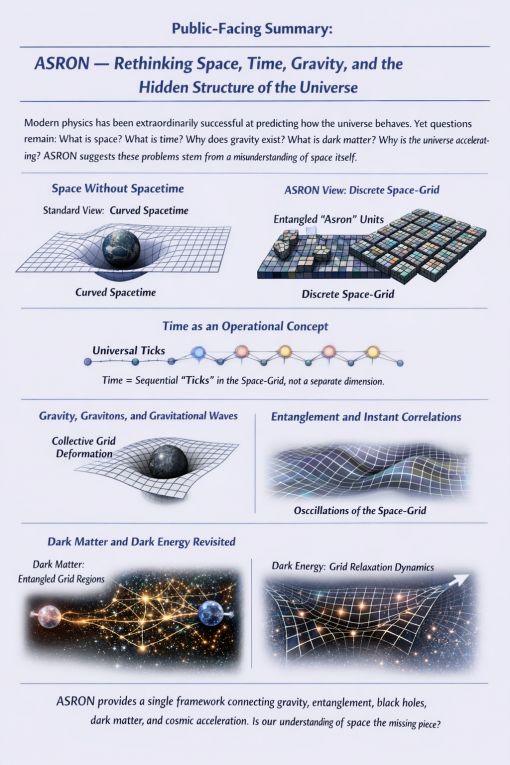
Popüler Özet – ASRON Yaklaşımıyla Evrene Yeni Bir Bakış Modern fizik, evreni anlamada büyük başarılar elde etti. Özellikle Albert Einstein’ın Genel Görelilik Kuramı, yerçekiminin nasıl işlediğini, gezegenlerin ve yıldızların nasıl hareket ettiğini, kara deliklerin ve kütleçekim dalgalarının varlığını olağanüstü bir doğrulukla açıklıyor. Bugün GPS uydularından kara delik gözlemlerine kadar pek çok teknoloji ve gözlem, bu teorinin doğruluğunu defalarca kanıtlamış durumda. Ancak tüm bu başarıya rağmen, modern fizik hâlâ bazı derin kavramsal sorunlarla karşı karşıya. Kara deliklerin merkezindeki “sonsuzluklar”, zamanın kara delik yakınında durması, bilginin kaybolup kaybolmadığı tartışması, kuantum fiziği ile yerçekiminin bir türlü tam olarak birleştirilememesi… Bunlar matematiksel değil, ontolojik (yani “gerçeklik nedir?” sorusuna dair) problemlerdir. ASRON yaklaşımı, bu sorunların kaynağının Einstein’ın denklemlerinde değil, bu denklemleri nasıl yorumladığımızda yattığını savunur. Uzay-Zaman Gerçek mi, Bir Anlatım Aracı mı? Einstein, evrendeki hareketleri ve yerçekimini açıklamak için “uzay” ve “zaman”ı tek bir geometrik yapı altında birleştirdi: uzay-zaman. Bu, son derece güçlü bir matematiksel araçtır. Ancak ASRON’a göre burada kritik bir ayrım gözden kaçırılmıştır: Bir modelin doğru sonuç vermesi, onun betimlediği şeyin ontolojik olarak gerçek olduğu anlamına gelmez. Tıpkı perspektif çizimde tren raylarının uzakta birleşiyor gibi görünmesi ama gerçekte hep paralel kalması gibi; uzay-zaman da fiziksel gerçekliğin kendisi değil, onu anlatmak için icat edilmiş bir perspektiftir. ASRON, bu nedenle uzay-zamanı “temel varlık” olmaktan çıkarır ve yerine yalnızca uzayı koyar. ASRON Nedir? Uzayın Yapıtaşları ASRON modeline göre uzay:
Bu ağ:
Kütle ve enerji, bu uzay-ağını gerer, zorlar ve işleyişini değiştirir. Yerçekimi dediğimiz şey de, uzayın bu kolektif tepkisidir. Zaman Gerçek Değilse, Nedir? ASRON’a göre zaman:
Bir parçacığın bir Asron bloktan diğerine geçmesi, en temel hareket birimidir. Buna “Evrensel Tik (Universal Tick)” denir. Bizim “saniye” dediğimiz şey, aslında:
Bu nedenle:
Zamanın Yavaşlaması ve Eşdeğerlik İlkesi Einstein’ın zaman genişlemesiyle ilgili öngörüleri ASRON’da aynen korunur:
Ancak yorum değişir: Zaman yavaşlamaz; uzayın işlem kapasitesi düşer. Bu, bir bilgisayarın ağır bir program altında yavaşlaması gibidir. Saat bozulmaz, uzay “gecikir”. Kara Delikler: Sonsuzluk Değil, İşlev Sınırı Klasik yorumda kara delikler:
ASRON’a göre ise:
Asron blokları Planck ölçeğinin altına sıkıştırılamaz. Bloklar kırılmaz; ancak iki blok arasındaki bağ işlevini kaybeder. Bu sınır:
Bu nedenle kara delik:
Bilgi, Entropi ve Hawking Işıması ASRON, kara deliklerle ilgili bilgi paradoksunu da farklı yorumlar:
Entropi:
Hawking ışıması ise:
Bu açıklama:
Kütleçekim Dalgaları ve Graviton Meselesi 2015’te gözlemlenen kütleçekim dalgaları:
Bu yüzden:
Spin-2 tanımı:
Neden Bu Yaklaşım Önemli? ASRON:
Bu yaklaşım henüz tamamlanmış bir teori değil; ancak:
Son Söz ASRON, “Einstein yanlıştı” demez. Einstein doğru hesapladı; biz gerçeği farklı bir dille anlatıyoruz. Zamanı temel almadan, uzayı merkezine alan bu yaklaşım; evrene bakışımızda yeni bir kapı aralıyor.
ASRON: A Conceptual Reframing of Gravity, Time, and Space Modern physics rests on two extraordinarily successful pillars: General Relativity and Quantum Field Theory. Each describes its own domain with remarkable precision. Yet, when confronted with phenomena such as black hole interiors, singularities, quantum gravity, or the nature of operational time itself, these frameworks reveal deep conceptual tensions. The ASRON framework does not attempt to replace General Relativity’s predictive power. Instead, it proposes an ontological reinterpretation of what General Relativity already describes so successfully. In this sense, ASRON is not a competing model but a foundational reframing. Descriptive Success vs. Ontological Commitment Einstein’s field equations yield experimentally verified predictions:
However, the mathematical success of a theory does not automatically imply that its descriptive entities must be physically real. A familiar analogy is perspective drawing: parallel railway tracks appear to converge at infinity, yet we know they remain parallel. The mathematical representation works perfectly for measurement and prediction, but its apparent geometry does not reflect physical reality. ASRON argues that spaceoperational time plays a similar role. It is an extraordinarily effective descriptive construct, but not necessarily the fundamental structure of reality. Space as the Only Fundamental Arena In ASRON, space alone is fundamental. Space is not continuous and featureless, but composed of discrete, quantized units—Asron blocks—each defined at the Planck volume scale. These blocks form a vast, interconnected space-grid that underlies all physical processes. Matter and energy do not move “through spaceoperational time” but operate within this spatial grid, locally modifying its structure and operational capacity. Gravity, in this view, is not curvature of spaceoperational time, but the collective mechanical response of the space-grid to mass–energy distributions. Time as a Derived Measure, Not a Dimension Time, within ASRON, is not an intrinsic dimension of the universe. Instead, operational time is:
The most elementary physical action is a transition from one Asron block to a neighboring one. This transition is called a Universal Tick. All clocks—atomic, mechanical, biological—ultimately count such transitions. Whether an observer labels them as seconds, years, or nanoseconds is a matter of scale, not ontology. Thus:
Reinterpreting Time Dilation Relativistic operational time dilation remains fully intact in ASRON, but its interpretation changes. In strong gravitational fields or at high velocities:
To an observer, this appears as operational time dilation. This preserves:
without treating operational time as a physical dimension. The Two-Tick Operational Limit A critical consequence of discretized space is the Two-Tick Inequality. Asron blocks cannot be compressed beyond Planck-scale volume. They do not fracture; rather, the bonding between adjacent blocks loses functional integrity. To traverse an Asron block fully requires two universal ticks:
Attempting to force a transition in fewer than two ticks violates the grid’s operational limit. This constraint reproduces:
Importantly, this limit mirrors the operational consequences of Einstein’s tensor equations—without requiring spaceoperational time curvature as a physical entity. Black Holes: Coherence Limits, Not Singular Objects Within ASRON, black holes do not contain physical singularities. A singularity is understood as:
Near the event horizon:
This results in an information horizon, not a point of infinite density. Inside the horizon, classical physics loses applicability—not because physics vanishes, but because external operational access vanishes. Entropy and Information Accessibility Entropy in ASRON is reinterpreted as: a measure of lost accessibility to information, not its destruction. Information is preserved globally within the space-grid, but becomes operationally unreachable beyond certain coherence thresholds. This perspective naturally accommodates:
Hawking Radiation as a Boundary Phenomenon Hawking radiation arises, in ASRON, from near-horizon grid oscillations. At the coherence boundary:
This preserves Hawking’s thermodynamic conclusions without requiring spaceoperational time itself to behave as a physical medium. Gravitational Waves and the Absence of the Graviton Gravitational waves are interpreted as coherent oscillatory modes of the space-grid. In this framework:
The spin-2 mathematical structure arises as an effective collective description of grid dynamics, explaining why graviton detection has remained elusive. Position Among Quantum Gravity Approaches ASRON differs from:
Instead, ASRON:
Conclusion ASRON does not deny General Relativity—it reinterprets its success. Einstein’s equations work because they capture the operational behavior of space under stress. But the deeper ontological picture may not require spaceoperational time as a fundamental entity at all. In this sense, ASRON offers:
ASRON: Rethinking Gravity, Time, and Space (Extended Popular–Academic Summary) Modern physics has achieved extraordinary success in describing the universe. Einstein’s General Relativity explains gravity with remarkable accuracy, predicting phenomena such as gravitational lensing, operational time dilation, black holes, and gravitational waves—all of which have been confirmed experimentally. Yet, despite this success, fundamental questions remain unresolved. What is operational time, really? What happens inside a black hole? Why do singularities appear in our equations? And why has gravity resisted quantization while all other fundamental interactions have not? The ASRON framework begins from a simple but radical observation: A theory can be descriptively correct while ontologically mistaken. Descriptive Accuracy vs. Physical Reality Einstein’s equations work exceptionally well. But mathematical success does not guarantee that the conceptual entities used in a theory correspond directly to physical reality. A classic analogy is perspective in drawing. Two parallel railway tracks appear to converge at infinity, even though we know they remain parallel everywhere. The perspective representation is extremely useful—it allows correct measurements, predictions, and visual consistency—yet the convergence itself is not physically real. ASRON proposes that spaceoperational time plays a similar role in modern physics. It is an extraordinarily powerful descriptive construct, but not necessarily a fundamental physical substance. Space as the Fundamental Entity In the ASRON model, space alone is fundamental. Space is not continuous and smooth at the deepest level. Instead, it is composed of discrete, quantized units called Asron blocks, each defined at the Planck-volume scale. These blocks form a vast, interconnected space-grid that underlies all physical phenomena. Matter and energy do not curve spaceoperational time. Rather, they interact with this space-grid, locally modifying its structure, coherence, and operational capacity. Gravity emerges as the collective mechanical response of the grid to mass–energy distributions. Time Without a Time Dimension One of ASRON’s most important departures from conventional thinking concerns operational time. In this framework, operational time is not a fundamental dimension of the universe. Instead, it is an operational construct—an accounting tool invented to measure change. What we call “operational time” is simply the counting of sequential motion across the space-grid. The smallest possible physical action is the transition from one Asron block to a neighboring one. ASRON calls this transition a Universal Tick. All clocks, regardless of their design, ultimately count such transitions. Seconds, years, and nanoseconds are human-defined scales layered on top of this deeper process. Time does not flow. What changes is the rate at which spatial operations can occur. Why Time Appears to Slow Down Relativistic operational time dilation remains fully valid in ASRON, but its interpretation changes. Near massive objects or at very high velocities:
To an external observer, this manifests as operational time dilation. Ontologically, however, it is not operational time itself that slows, but the operational capacity of space. This reinterpretation preserves all experimentally verified predictions of General Relativity, including:
The Two-Tick Operational Limit A key result of discrete space is the Two-Tick Inequality. Asron blocks cannot be compressed beyond Planck-scale volume. They are not destroyed under extreme conditions; instead, the bonding between adjacent blocks progressively loses functional integrity. To fully traverse an Asron block requires two Universal Ticks—one to enter and one to exit. Any attempt to force a transition faster than this violates the grid’s operational limit. This naturally explains:
Remarkably, this operational constraint reproduces the effective consequences of Einstein’s Field Equations without treating spaceoperational time as a physical entity. Black Holes Without Singularities In ASRON, black holes do not contain physical singularities. A singularity is understood as a signal that a descriptive framework has reached its limit, not as a real object with infinite density. Near a black hole’s event horizon, the space-grid reaches a coherence limit where normal information transmission ceases to function. The event horizon thus becomes an information boundary, not a physical surface. Inside this boundary, classical descriptions lose meaning—not because physics disappears, but because external operational access is no longer possible. Entropy and Information Entropy, within ASRON, is interpreted as a measure of lost accessibility to information, not information destruction. Information remains globally preserved within the space-grid but becomes operationally unreachable beyond certain coherence thresholds. This resolves long-standing paradoxes related to black hole entropy and information loss while remaining consistent with thermodynamics. Hawking Radiation Revisited Hawking radiation is described as a boundary phenomenon arising from near-horizon grid oscillations. At the coherence limit:
This preserves Hawking’s results without requiring spaceoperational time itself to behave as a physical medium. Gravitational Waves and the Missing Graviton Gravitational waves are interpreted as coherent oscillations of the space-grid. Gravity is not mediated by a fundamental particle in this framework. The familiar spin-2 structure appears as an effective mathematical description of collective grid modes, explaining why the graviton has never been observed despite decades of effort. Position Among Modern Theories Unlike string theory, loop quantum gravity, or emergent gravity models, ASRON:
It does not replace General Relativity’s equations; it replaces the ontological assumptions beneath them. Final Perspective ASRON suggests that many of the deepest puzzles in modern physics arise not from incorrect equations, but from mistaking descriptive tools for physical reality. By grounding gravity, operational time, and information in a discrete space-grid, the model offers a conceptually simpler and more coherent foundation—while preserving everything that experiments have already confirmed.
**Public-Facing Summary: ASRON — Rethinking Space, Time, Gravity, and the Hidden Structure of the Universe** Modern physics has been extraordinarily successful at predicting how the universe behaves. Einstein’s General Relativity describes gravity with stunning accuracy, and quantum theory explains the behavior of matter at the smallest scales. Yet despite these successes, some of the most basic questions remain unanswered. What is space? What is time? Why does gravity exist at all? What is dark matter? Why is the universe accelerating? These unresolved questions are often treated as separate mysteries, each requiring its own explanation. ASRON begins from a different assumption: that many of these problems arise not because our equations are wrong, but because we may be misunderstanding what space itself actually is. Space Without Spacetime In standard physics, gravity is described as the curvature of spacetime. This idea works mathematically, but it leaves a crucial question unanswered: what is spacetime made of? Is it a physical substance, or merely a convenient way of describing motion and gravity? ASRON proposes that spacetime is not a physical entity at all. Instead, space is composed of discrete, entangled units—called Asron blocks—that form a coherent structure known as the space-grid. This grid is not a material medium like air or water, but a fundamental structural substrate underlying all physical phenomena. Spacetime, in this view, is an effective description—much like perspective in drawing. Parallel railroad tracks appear to converge in the distance, even though they never physically do. The perspective model is accurate and useful, but the rails themselves do not change. Similarly, spacetime curvature correctly predicts gravitational effects without requiring spacetime itself to be physically bent. Time as an Operational Concept One of the most counterintuitive aspects of modern physics is time dilation: clocks run slower near massive objects or at high speeds. ASRON reproduces these effects exactly—but without treating time as a fundamental dimension. In ASRON, time is an operational measure, not a physical substance. The smallest unit of motion is a transition from one Asron block to the next, called a universal tick. Counting these ticks provides what we call time. Under gravity or motion, these transitions become operationally slower—not because time itself slows down, but because the space-grid’s structure changes. This explains why time dilation occurs near black holes or at relativistic speeds while preserving all experimentally verified predictions of relativity. Gravity, Gravitational Waves, and the Missing Graviton ASRON interprets gravity as a collective behavior of the space-grid rather than as a force or a particle exchange. Mass and energy deform the grid’s coherence, producing gravitational effects. Gravitational waves, detected by LIGO and Virgo, are understood as coherent oscillations of the space-grid. This interpretation is fully consistent with Einstein’s equations, but it naturally explains why a fundamental graviton particle has never been detected. In ASRON, the graviton is not a fundamental particle at all; the familiar “spin-2” mathematical structure reflects collective grid behavior, not an elementary object. Black Holes, Horizons, and Information Black holes present some of the deepest paradoxes in physics. Classical theory predicts singularities—points of infinite density—where physics breaks down. ASRON removes these infinities entirely. In this framework, a black hole represents a grid coherence limit. Beyond this limit, classical descriptions lose meaning, but the underlying structure does not physically collapse into infinity. The event horizon is not a wall or a surface; it is an information boundary. Information is not destroyed—it becomes inaccessible. Entropy, therefore, measures not disorder or destruction, but loss of accessibility across this boundary. Hawking radiation arises from boundary-level fluctuations of the grid, preserving thermodynamic behavior without invoking physical spacetime evaporation. Quantum Entanglement and Instant Correlations Quantum entanglement remains one of the most puzzling phenomena in physics. Particles appear to share information instantly, regardless of distance. ASRON explains this naturally. Entanglement arises from nonlocal connectivity within the space-grid itself. No signal travels faster than light; instead, correlated regions share a common structural link. This preserves relativistic causality while removing the mystery of “spooky action at a distance.” Dark Matter and Dark Energy Revisited Despite decades of searching, no dark matter particles have been directly detected. ASRON suggests a different interpretation: dark matter effects arise from gravitational participation of entangled grid regions that do not interact electromagnetically with ordinary matter. Similarly, dark energy is interpreted not as vacuum energy, but as large-scale relaxation dynamics of the space-grid. The accelerating expansion of the universe reflects structural behavior of the grid itself, avoiding extreme fine-tuning problems. Why ASRON Matters ASRON does not replace existing equations or discard successful theories. Instead, it provides a physical foundation beneath them, explaining why they work and where their conceptual limits lie. By unifying gravity, time, quantum entanglement, black holes, dark matter, and dark energy within a single ontological framework, ASRON suggests that many of modern physics’ greatest mysteries are not separate problems—but different perspectives on the same underlying structure. This shift does not end physics; it refocuses it. Rather than asking what new entities must be added, ASRON asks whether we have misunderstood the nature of space itself. Final note for readers ASRON is a foundational proposal, not a finished theory. Its purpose is to clarify the physical picture underlying known phenomena and to guide future theoretical and experimental exploration. Whether it ultimately proves correct will depend on continued observation, mathematical refinement, and empirical testing. What it offers now is a coherent way to think differently—yet consistently—about the universe we already measure.
Academic & Skeptic FAQ
No. ASRON does not modify, replace, or invalidate Einstein’s Field Equations. All experimentally verified predictions of General Relativity—such as gravitational lensing, operational time dilation, gravitational redshift, and gravitational waves—are preserved. ASRON addresses the ontological interpretation of what these equations describe, not their mathematical structure or empirical accuracy.
Mathematical effectiveness does not require ontological identity. Just as perspective geometry accurately predicts visual measurements without implying that parallel lines physically converge, spaceoperational time provides an effective descriptive framework for relational dynamics. ASRON argues that spaceoperational time is a powerful emergent representation of deeper space-grid dynamics.
Time is not eliminated but redefined as an operational construct. It is not treated as a fundamental dimension of reality, but as a measure derived from sequential motion across the space-grid. All physical clocks ultimately count transitions between Asron blocks (Universal Ticks), making operational time a bookkeeping tool rather than a physical substrate.
Time dilation arises from operational slowdown of space-grid transitions under mass–energy stress or high relative motion. The grid requires increased coordination to maintain coherence, reducing the rate of effective transitions. This reproduces all relativistic dilation effects without invoking deformation of a physical operational time dimension.
Spaceoperational time curvature is replaced by collective mechanical deformation and coherence variation of the space-grid. Einstein’s tensor remains mathematically valid as an effective descriptor of how mass–energy distributions influence grid behavior.
Gravitational waves are interpreted as coherent oscillations of the underlying space-grid. Their observed properties—speed, waveform, polarization, and energy transport—are preserved. No fundamental graviton is required; the familiar spin-2 structure represents an effective collective mode.
In ASRON, gravity is not mediated by a fundamental particle. The graviton appears as an effective description of collective grid dynamics rather than an independent quantum entity. This naturally explains its persistent non-detection without conflicting with observed gravitational phenomena.
A black hole is a coherence-limit structure of the space-grid. It does not contain a physical singularity. The event horizon represents a boundary beyond which external operational access to information fails, not a point of infinite density.
Classical descriptions lose applicability because grid coherence no longer supports external information transfer. This does not imply physical inconsistency, but rather the breakdown of externally meaningful observables.
Entropy measures the loss of accessibility to information, not information destruction. Information remains globally preserved within the space-grid, even when it becomes operationally unreachable beyond coherence limits.
Yes. Information is preserved globally while becoming locally inaccessible. Hawking radiation is interpreted as a boundary phenomenon arising from near-horizon grid oscillations, allowing energy leakage without revealing internal microstates.
Hawking radiation emerges from fluctuations at the grid’s coherence boundary. Thermal radiation arises naturally while detailed internal state information remains inaccessible, preserving thermodynamic consistency without requiring spaceoperational time to be a physical medium.
ASRON is designed to be compatible with quantum constraints by quantizing space itself rather than spaceoperational time. It avoids introducing continuous singularities and does not require additional dimensions or speculative entities.
Loop quantum gravity quantizes spaceoperational time; string theory introduces additional dimensions and fundamental strings. ASRON quantizes space alone, treats operational time as derived, and interprets gravity as a collective mechanical response of the space-grid.
ASRON preserves all current experimental predictions of General Relativity, so it does not generate immediate contradictions. Potential tests lie in extreme regimes: black hole horizons, quantum coherence limits, gravitational wave microstructure, and information-theoretic signatures beyond classical spaceoperational time descriptions.
No. ASRON is a foundational framework intended to clarify ontological assumptions and resolve conceptual inconsistencies. It aims to provide a coherent basis upon which further theoretical and experimental work can be developed.
Because predictive success does not guarantee conceptual completeness. ASRON addresses unresolved foundational issues—singularities, information paradoxes, and the nature of operational time—while preserving everything that already works.
ASRON is speculative in ontology, not in empirical claims. It does not contradict observations and remains fully consistent with tested physics. Its purpose is conceptual clarification rather than immediate phenomenological novelty.
No. ASRON remains within physical ontology, proposing discrete spatial structure and operational definitions. It avoids metaphysical commitments beyond what is already implicit in modern physics.
ASRON offers an ontological replacement for spaceoperational time beneath Einstein’s descriptive solutions, preserving empirical success while resolving foundational paradoxes related to gravity, operational time, and information.
“ public-facing” özet (basın / web için) old version A New Way to Understand Space, Time, and Gravity Einstein’s theory of gravity has described the universe with extraordinary accuracy for more than a century. It explains why clocks run slower near massive objects, how black holes form, and how gravitational waves travel across the cosmos. Yet some of the deepest questions remain open: What is operational time, really? Why do singularities appear in our equations? And why has gravity resisted a clear quantum description? The ASRON framework proposes that these problems arise not from incorrect equations, but from how we interpret them. Space Is Fundamental — Time Is Not According to ASRON, space is the fundamental structure of the universe, but operational time is not a physical substance or dimension. Time is instead an invented measurement system, created to count change and motion. At the deepest level, the universe is built from tiny, indivisible units of space called ASRON blocks, arranged as a vast space-grid. The smallest possible physical action is moving from one block to a neighboring one. ASRON calls this step a Universal Tick. What we normally call “operational time” is nothing more than counting these ticks. Seconds, minutes, and years are human-defined scales layered on top of this process. Time does not flow, slow down, or bend. What changes is the operational behavior of space itself. Why Clocks Slow Down Near Mass When matter or energy is present, it strains the space-grid. Under strong gravity or high speed, the grid becomes harder to operate, requiring more global coordination for each Universal Tick. To observers, this appears as operational time dilation—clocks ticking more slowly. In ASRON, nothing happens to operational time. Instead, space becomes operationally slower. This interpretation preserves all of Einstein’s experimentally verified results, including gravitational redshift, velocity-dependent operational time dilation, and the equivalence principle. Black Holes Without Infinite Points In ASRON, black holes do not contain physical singularities. A singularity is understood as a sign that a descriptive model has reached its limit, not as a real object with infinite density. A black hole marks a coherence limit of the space-grid. Beyond this limit, information can no longer be transmitted outward. The event horizon is therefore an information boundary, not a physical wall. Entropy and Information Information is never destroyed in ASRON. What increases is inaccessibility. Entropy measures how much information becomes unreachable due to limits in space-grid coherence. This naturally resolves the black hole information paradox without violating thermodynamics. Gravitational Waves and the Missing Graviton Gravitational waves, directly observed by LIGO, are interpreted as vibrations of the space-grid itself. Gravity is not carried by a particle; it emerges from the collective behavior of space. This explains why the graviton has never been detected: it is not a fundamental particle, but an effective mathematical description of grid oscillations. What ASRON Changes — and What It Does Not
ASRON keeps everything that experiments have already confirmed. It does not change Einstein’s equations. What it changes is what those equations are assumed to describe. By treating space as fundamental and operational time as an operational tool, ASRON offers a simpler, more coherent picture of gravity, black holes, and the flow of the universe—one that removes long-standing paradoxes without adding speculative dimensions or untested entities.
three one-sentence hook options tailored for popular-science audience. Option 1 — Curiosity-driven (editor-friendly): Option 2 — Bold but careful: Option 3 — Visual / metaphorical: Headline-style (clean, editorial-ready) A Hidden Cosmic Ground May Link Gravity, Quantum Entanglement, and the Universe’s Dark Side Punchier (attention-grabbing, high-impact) What If Space Itself Is Hiding the Answer to Dark Energy, Gravity, and Quantum Weirdness? | |||||||||||||||||||||||||||||||||||||||||||||||||||||||||||||||||||||||||||||||||||||||||||||||||||||||||||||||||||||||||||||||||||||||||||||||||||||||||||||||||||||||||||||||||||||||||
|
4 kez okundu
YorumlarHenüz yorum yapılmamış. İlk yorumu yapmak için tıklayın |